


Applied Optoelectronics (AAOI) develops optical transceivers, lasers and hybrid fiber-coaxial networking equipment for AI data centers, cloud infrastructure and broadband networks. Its 800G and 1.6T products are turning the company into a focused AI connectivity supplier, while CATV equipment remains an important revenue base. This transition increases the growth opportunity and leaves the stock sensitive to customer concentration, manufacturing execution and capital intensity.
The latest quarter showed that the transition is accelerating, though profitability still trails revenue growth. AAOI Q2 revenue rose 86.4% year over year, datacenter sales more than doubled, and the company returned to non-GAAP profitability. GAAP gross margin declined during the expansion, so the investment case depends on whether new capacity can raise shipment volume without extending the period of weak cost absorption.
The AAOI stock forecast for 2026 now centers on two competing views:
- The optical capacity case: Booked demand for 800G and 1.6T products fills new production lines, drives sequential revenue growth and restores operating leverage.
- The execution and dilution case: Ramp costs, customer concentration and equity funding limit per-share earnings even if reported revenue continues to rise.
This guide breaks down the AAOI stock forecast, 2026 price scenarios, key risks, and analyst outlooks, drawing on Applied Optoelectronics' August 6 Q2 earnings release, quarterly filing and market data through September 2, plus how to trade AAOI stock futures on BingX TradFi with USDT collateral.
Top 5 Things for AAOI Investors to Know in September 2026
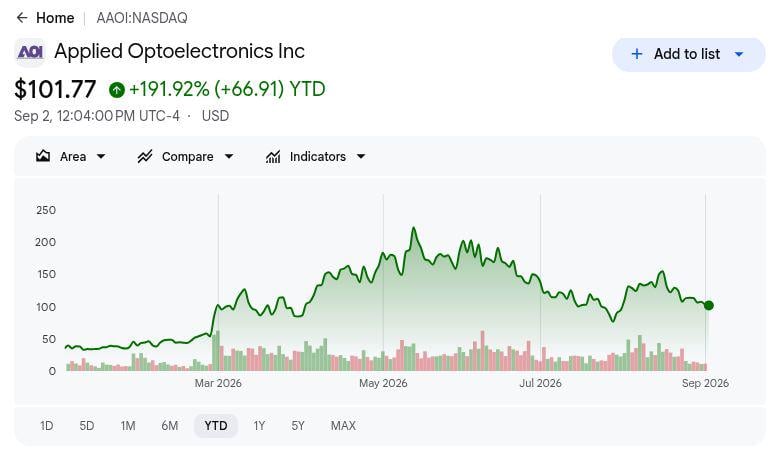
- AAOI was up 191.92% YTD through September 2: The rally came as Q2 revenue reached $191.9 million, up 86.4% year over year, and data-center sales more than doubled. That leaves a much higher execution bar for capacity utilization and margin recovery.
- Q2 revenue of $191.9 million set a fifth consecutive quarterly record: Revenue also increased 27% sequentially, showing that datacenter and CATV demand was converting into actual shipments rather than remaining only a backlog or qualification story.
- Datacenter revenue reached $107.7 million, up 140.4% year over year: The segment represented more than half of total sales, making high-speed 800G and 1.6T optics the main growth engine. That also increases exposure to hyperscaler program timing and customer concentration.
- Monthly high-speed capacity could rise from about 200,000 units toward 650,000 units: Management’s year-end target implies more than a threefold increase in production capability, making utilization, yields, and margin conversion critical to the next phase of the story.
- Selected analyst targets range from $109 to $220: The $111 spread reflects strong agreement on revenue growth but much less agreement on profitability. With GAAP gross margin at 27.7% versus 30.3% a year earlier, investors still need evidence that faster shipments can translate into stronger per-share earnings.
What Is Applied Optoelectronics (AAOI)?
Applied Optoelectronics (AAOI) is an optical-networking company focused on data-center connectivity. It designs and manufactures lasers, optical components, transceivers, and HFC access-network products used across cloud, telecom, CATV, and fiber-access systems. Unlike many fabless semiconductor companies, AAOI operates vertically integrated manufacturing across the United States and Asia, giving it more control over laser production, module assembly, and the high-speed optical products needed for 800G and 1.6T deployments.
Its growth strategy is increasingly centered on AI data centers and large hyperscale customers. AAOI has historically supplied major technology customers including NVIDIA and Cisco, while newer 800G and 1.6T programs are being qualified and ramped with additional hyperscale data-center customers. The company is expanding vertically integrated laser and transceiver capacity to support those programs, using more in-house lasers and light engines to improve control over cost, supply, and product performance. That strategy positions AAOI deeper in the high-speed interconnect layer of AI infrastructure as cluster bandwidth requirements increase.
Read More: Top AI Optical Stocks to Buy in 2026: Photonics, Optics, Fiber, and Data Center Interconnects
AAOI Q2 2026 Earnings Overview: Revenue, EPS and Margins
AAOI delivered exceptional Q2 revenue growth and returned to adjusted profitability, but margins remained under pressure as production capacity scaled. Revenue reached $191.9 million versus $190.5 million expected, non-GAAP EPS came in at $0.06 versus $0.02, and datacenter revenue surged to $107.7 million. At the same time, GAAP gross margin fell to 27.7%, showing that shipment growth is still running ahead of full operating leverage.
Read More: AAOI Q2 2026 Earnings News: $191.9M Revenue and 800G Ramp Drive a 9.19% Price Rally
|
Financial Metric |
Guidance / Consensus |
Reported / Actual |
Surprise |
|
Q2 2026 revenue |
$190.5 million consensus |
$191.9 million |
Beat. Slightly above the tracked estimate and up 86.4% year over year. |
|
Q2 2026 non-GAAP diluted EPS |
$0.02 consensus |
$0.06 |
Beat. Returned the company to adjusted profitability. |
|
Q2 2026 GAAP net loss |
— |
$22.8 million |
Widened. Expansion costs kept statutory earnings negative. |
|
Q2 2026 GAAP gross margin |
— |
27.70% |
Declined. Down from 30.3% one year earlier during the production ramp. |
|
Q2 2026 datacenter revenue |
— |
$107.7 million |
Surged. Up 140.4% year over year as high-speed optics scaled. |
|
Q2 2026 CATV revenue |
— |
$80.6 million |
Expanded. Up 43.8% year over year on 1.8 GHz product adoption. |
|
Q3 2026 revenue guidance |
— |
$255 million to $290 million |
Raised. Implies another major sequential step-up if capacity comes online. |
|
Q3 2026 non-GAAP gross-margin guidance |
— |
29% to 30.5% |
Measured. Shows gradual rather than immediate operating leverage. |
|
Cash, equivalents and restricted cash |
— |
$508.8 million |
Strengthened. Provides funding for the capital-intensive capacity build. |
- Revenue of $191.9 million grew 86.4% year over year: The result slightly exceeded the $190.5 million consensus and advanced 27% sequentially, showing that datacenter and CATV demand converted into shipments faster than expected.
- Non-GAAP diluted EPS of $0.06 beat the $0.02 estimate: AAOI returned to adjusted profitability after losses in the prior quarter and prior-year period, though a $22.8 million GAAP net loss shows the earnings base is still developing.
- Datacenter revenue reached $107.7 million, up 140.4%: The segment accounted for more than half of total revenue and became the main growth engine as 800G products scaled and 1.6T programs advanced.
- GAAP gross margin fell to 27.7% from 30.3%: Rapid production expansion and product mix offset some of the benefit from higher sales, making margin recovery the clearest test of whether new capacity can create operating leverage.
- Q3 revenue guidance rose to $255 million to $290 million: The range points to another major sequential increase, while non-GAAP gross-margin guidance of 29% to 30.5% suggests profitability should improve gradually as utilization rises.
Cash, equivalents and restricted cash reached about $508.8 million, giving AAOI more resources to fund equipment, inventory, and manufacturing expansion. The key question now is whether that investment can turn higher output into stronger margins and cash earnings without requiring excessive dilution.
AAOI 2026 Investment Outlook: $250 Bull Case vs. $80 Bear Case
The central test is whether high-speed optics demand can convert into utilization, margin recovery and stronger per-share earnings.
The Bull Case: 1.6T Adoption Pushes AAOI Toward $250
The Bull Case assumes 800G demand remains strong while 1.6T products move from qualification into meaningful volume. New manufacturing lines fill quickly, yields improve, and datacenter mix supports another series of above-plan revenue quarters, with CATV providing additional diversification.
A move toward $250 would require rising capacity utilization, stable customer deployment schedules, and better margin conversion as output scales. Stronger 1.6T shipments and continued revenue beats would provide the clearest confirmation.
The Base Case: Continued Shipment Growth Keeps AAOI Between $140 and $185
The Base Case assumes shipment growth continues and non-GAAP gross margin improves gradually as new capacity comes online. Revenue momentum remains stronger than GAAP profitability, while utilization and product mix take several quarters to mature.
Under this scenario, AAOI could trade mainly between $140 and $185. Results near the upper end of guidance, stable qualification timelines, and improving margins would support the range, while faster inventory or receivables growth would weaken it.
The Bear Case: Ramp Delays and Dilution Pull AAOI Toward $80
The Bear Case assumes slower customer deployments, component shortages, or weak manufacturing yields prevent new equipment from reaching planned utilization. Revenue could still grow year over year, but earnings expectations would fall if margins and cash conversion fail to improve.
A move toward $80 would become more likely if capacity remains underused, inventory builds, or additional equity funding is needed. In that environment, weaker per-share earnings and multiple compression could outweigh the long-term AI optics opportunity.
AAOI Stock Price Forecasts for 2026 By Wall Street Analysts
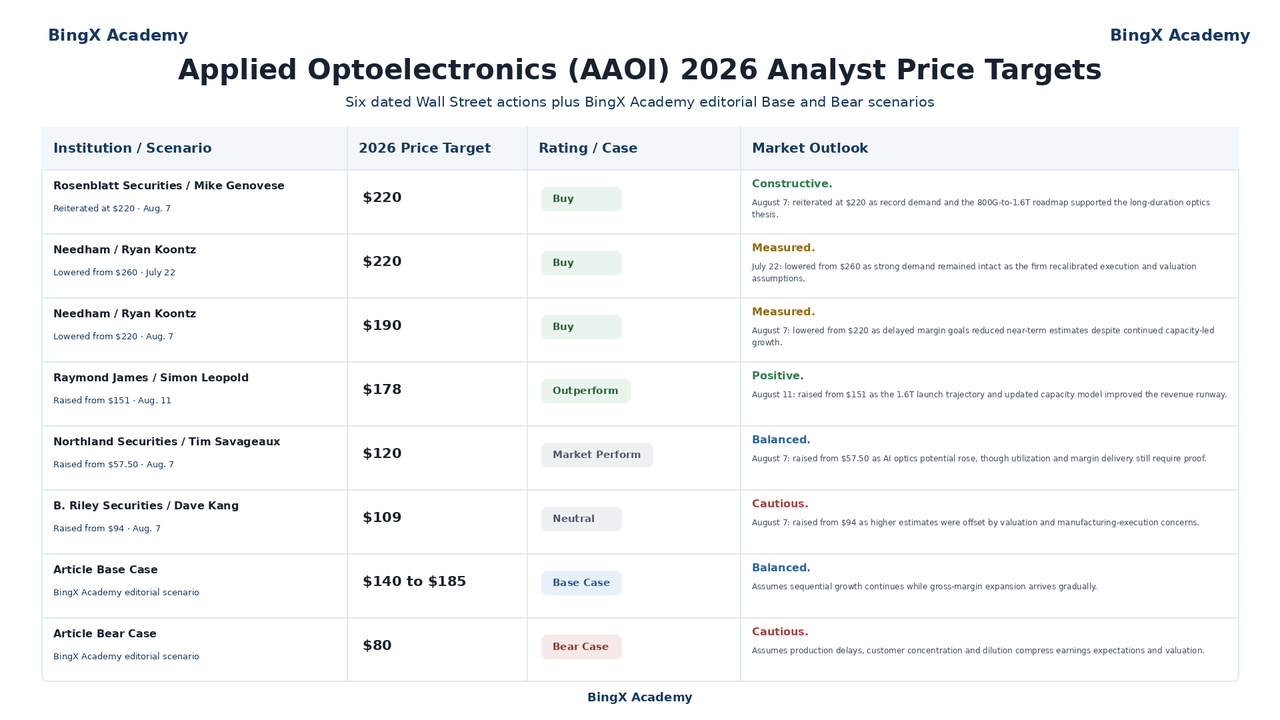
These six verified, dated actions are sorted from highest to lowest. The repeated Needham entries show two separate revisions during a fast-moving period. The final two rows are BingX Academy editorial scenarios rather than analyst forecasts.
|
Institution / Scenario |
2026 Price Target |
Rating / Case |
Market Outlook |
|
Rosenblatt Securities |
$220 |
Buy |
Constructive. August 7: reiterated at $220 as record demand and the 800G-to-1.6T roadmap supported the long-duration optics thesis. |
|
Needham |
$220 |
Buy |
Measured. July 22: lowered from $260 as strong demand remained intact as the firm recalibrated execution and valuation assumptions. |
|
Needham |
$190 |
Buy |
Measured. August 7: lowered from $220 as delayed margin goals reduced near-term estimates despite continued capacity-led growth. |
|
Raymond James |
$178 |
Outperform |
Positive. August 11: raised from $151 as the 1.6T launch trajectory and updated capacity model improved the revenue runway. |
|
Northland Securities |
$120 |
Market Perform |
Balanced. August 7: raised from $57.50 as AI optics potential rose, though utilization and margin delivery still require proof. |
|
B. Riley Securities |
$109 |
Neutral |
Cautious. August 7: raised from $94 as higher estimates were offset by valuation and manufacturing-execution concerns. |
|
Article Base Case |
$140 to $185 |
Base Case |
Balanced. Assumes sequential growth continues while gross-margin expansion arrives gradually. |
|
Article Bear Case |
$80 |
Bear Case |
Cautious. Assumes production delays, customer concentration and dilution compress earnings expectations and valuation. |
How to Trade Applied Optoelectronics (AAOI) Stock on BingX
Trade Applied Optoelectronics' AI-optics and manufacturing outlook using BingX TradFi and BingX AI tools. Because AAOI can react sharply to capacity updates, customer qualifications and margin guidance, traders should define the catalyst and risk limits before entering a position.
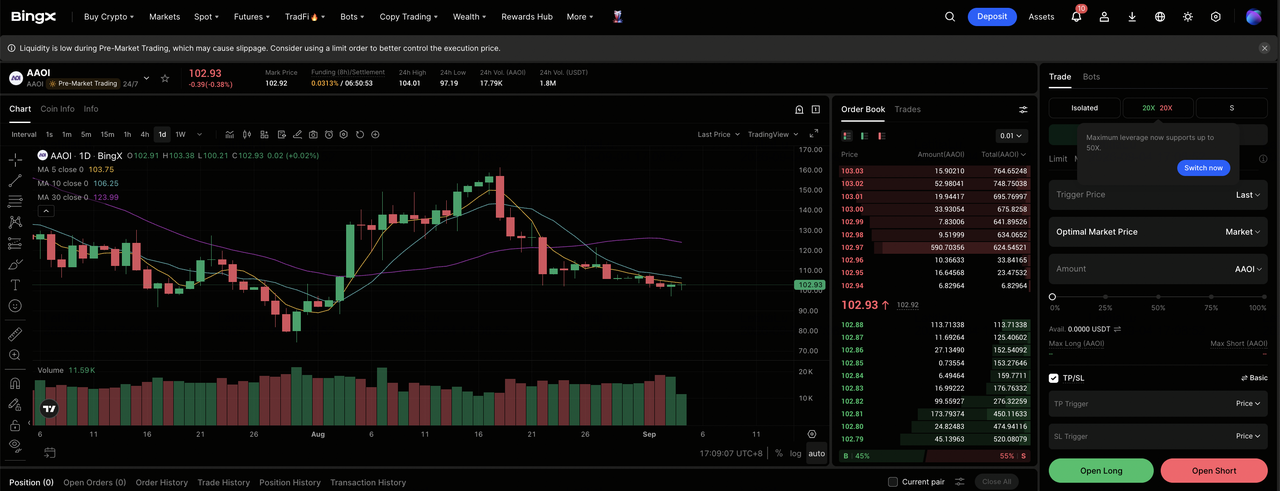
Step 1: Access BingX TradFi. Sign up, complete KYC, enable two-factor authentication, deposit USDT, and navigate to the TradFi section.
Step 2: Select Applied Optoelectronics (AAOI). Search for and select the AAOI-USDT perpetual futures contract. Confirm the symbol and trading session before entering an order.
Step 3: Choose your direction. Select Open Long if capacity utilization, 1.6T adoption and margin recovery support the bull or base case. Select Open Short if delays, dilution or customer concentration begin to validate the bear case.
Step 4: Select leverage and margin mode. Choose Isolated or Cross-Margin based on risk tolerance. The stock's large YTD move and earnings sensitivity make conservative leverage and clear position sizing important.
Step 5: Execute strict risk protocols. Set Take-Profit and Stop-Loss (TP/SL) levels before or immediately after entering the trade. Capacity milestones, customer orders, product qualifications and margin guidance can change the thesis quickly.
Top 5 Risks to Watch for Applied Optoelectronics Investors in 2026
AAOI’s growth opportunity is significant, but customer concentration, manufacturing execution, funding needs, product transitions, and valuation could all pressure returns if the capacity ramp falls short.
- Customer concentration can turn one delay into a major revenue reset: Large hyperscale programs account for a meaningful share of expected growth. A qualification delay or revised order schedule could quickly reduce utilization and earnings visibility.
- Manufacturing execution can block margin recovery: New lines require equipment installation, trained labor, yield improvement, and reliable component supply. Slower execution would keep unit costs elevated even if customer demand remains strong.
- Equity funding can dilute per-share upside: Capacity expansion and working capital require substantial cash. Additional share issuance can strengthen liquidity, but it also spreads future earnings across a larger share base.
- The 800G-to-1.6T transition can create timing and mix risk: Customers may adjust speed, form factor, and architecture choices as AI networks evolve. A slower transition could leave new equipment underused or require additional development spending.
- A high-growth valuation leaves little room for disappointment: AAOI has already been repriced around a major production ramp. Revenue that merely meets guidance, flat margins, or weaker cash conversion could trigger multiple compression even if year-over-year growth remains strong.
Final Thoughts: Should You Invest in Applied Optoelectronics in 2026?
AAOI's latest quarter established that high-speed optical demand is converting into record revenue and adjusted profitability. Datacenter growth, CATV demand and a larger balance sheet support the expansion plan. Margin, cash conversion and the larger share base remain the unresolved parts of the investment case.
The bull case requires full utilization and a successful 1.6T ramp; the bear case requires an observable production delay, customer pause or funding burden. Conservative traders may wait for another quarter of margin progress and evidence that working capital is scaling more slowly than revenue before treating the upper analyst cluster as durable.
Risk Reminder: Trading and investing in equities like AAOI involves a high risk of capital loss. Customer concentration, manufacturing execution, product transitions, dilution, valuation and leveraged contracts can produce rapid losses. Conduct independent research before allocating capital.
Related Reading
- Top AI Optical Stocks to Buy in 2026: Photonics, Optics, Fiber, and Data Center Interconnects
- Top AI Networking Stocks 2026: AI Fabric, Switches, Copper, Fiber, and Optics Connectivity
- Lumentum Stock Forecast 2026: Can AI Optics Boom, AI Data Center Supercycle Drive LITE Above $1,200?
- Corning (GLW) Price Prediction 2026: $228 Street-High Optical Boom or Cyclic Margin Trap?
- Coherent (COHR) Stock Price Prediction 2026: Can the AI Optics King Break $460 After Hitting $440?
- Ciena (CIEN) Price Prediction 2026: Can AI Optical Networking Demand Push CIEN Stock Toward $600?
