
In 2026, Brazil has transitioned from a developing crypto ecosystem into a globally recognized Licensed Jurisdiction. Following the full enforcement of BCB Resolutions 519, 520, and 521, the rules for interacting with digital assets are now as rigorous as traditional banking.
For the 6.5 million Brazilian crypto investors, understanding Brazil crypto regulation is no longer optional in 2026 but it is also the key to ensuring your account remains active, your transfers clear instantly via PIX, and your capital stays protected from the $54 billion lost annually to local fraud. This deep dive breaks down the compliance pillars of the Brazilian market and how they impact your experience on BingX.
The Regulators: Who Is Watching Your Crypto Trades in Brazil?
The Wild West era ended when the Brazilian government designated specific authorities to oversee every aspect of the virtual asset lifecycle.
- Central Bank of Brazil (BCB): The primary authority. The BCB issues licenses to Virtual Asset Service Providers (VASPs), monitors capital requirements, and oversees the Foreign Exchange (FX) perimeter for stablecoins.
- Securities and Exchange Commission (CVM): The CVM steps in whenever a digital asset behaves like a security, e.g., certain tokenized assets or ICOs.
- COAF: The intelligence unit that receives suspicious transaction reports (STRs) to combat money laundering.
In 2026, any platform operating in Brazil without BCB authorization faces IP blocking and payment disconnection. BingX prioritizes alignment with these standards to ensure uninterrupted service for the Brazilian community.
KYC (Know Your Customer) for Brazil's Crypto Traders: Why Your CPF Matters
Under Resolution 519/2025, anonymous crypto trading is effectively a thing of the past for regulated platforms. KYC AML crypto Brazil requirements mandate that every user must be uniquely identified through their CPF (Cadastro de Pessoas Físicas).
- Tiered Verification: Basic accounts may have lower limits, while Advanced KYC, requiring a liveness selfie and ID upload, is mandatory for PIX deposits exceeding R$50,000.
- Data Matching: Your bank account name must match your BingX KYC name. If a user attempts a PIX transfer from a third-party account, the transaction will be automatically reversed to prevent identity theft.
For BingX users, a completed KYC is the green pass for the Brazilian market. It unlocks the BingX P2P Marketplace and ensures your BRL-to-USDT conversions are flagged as Authorized by the Central Bank's monitoring systems.
AML (Anti-Money Laundering): Combatting the $2.4B Risk
With over $2.4B in crypto-related money laundering detected in Brazil between 2017 and 2024, the BCB has implemented Bank-Grade AML protocols.
- Transaction Monitoring: VASPs use automated tools to flag unusual patterns, such as rapid-fire transfers to unhosted wallets or high-volume activity inconsistent with a user's declared income.
- The Travel Rule (Resolution 520): In 2026, Brazil requires the Travel Rule for all domestic transfers. This means when you send crypto from one exchange to another, the originator and beneficiary information must travel with the transaction.
A major win for 2026 regulation is Mandatory Asset Segregation. Regulated platforms must keep client funds in dedicated accounts, separate from company operating capital, ensuring that even in a liquidity crisis, user BRL and crypto remain untouchable.
Stablecoins as Foreign Exchange (FX)
Perhaps the most significant shift in 2026 is the treatment of USDT and USDC. Because stablecoins account for 90% of Brazil's crypto volume, the BCB now treats these as Foreign Exchange Operations under Resolution 521.
- Reporting: Transfers involving stablecoins are subject to the same traceability rules as a USD wire transfer.
- Limits: Cross-border crypto services are capped at the equivalent of $100,000 for standard VASPs, while larger institutional flows require specific FX licensing.
By staying compliant and using verified channels like BingX, you avoid the Informal Market trap, unregulated P2P groups that often lead to bank account freezes and tax audits.
Comparison of Compliance Standards in Brazil (2026)
| Requirement | Retail Investor Impact | VASP/Exchange Requirement |
| Identity (KYC) | Mandatory CPF & Liveness check | Real-time identity validation |
| AML Monitoring | Source of Funds may be requested | 24/7 automated risk scoring |
| Travel Rule | Data shared between platforms | Interoperable data protocols |
| Tax (DeCripto) | Annual reporting of holdings | Monthly reporting of large trades |
In 2026, the compliance gap between retail investors and Virtual Asset Service Providers (VASPs) has widened into a high-stakes ecosystem defined by capital thresholds and data finality. Under BCB Resolution 519, VASPs must maintain minimum capital between $181,500 and $544,500, while retail investors are bound by a 17.5% flat capital gains tax that replaced the former R$35,000 exemption. The practical shift lies in Asset Segregation; unlike the pre-2026 era, licensed platforms are now legally required to hold client BRL and crypto in accounts entirely distinct from corporate treasury, reducing counterparty risk for the 6.5 million active users in the market.
Operationally, the Travel Rule (Resolution 520) has digitized the KYC process, making a verified CPF the only valid key for the 90% of transactions that now flow through stablecoins. For the practical trader, this means compliance is no longer a one-time onboarding hurdle but a continuous data-sharing loop. Any transaction exceeding R$30,000 triggers mandatory reporting to the Federal Revenue Service, and since stablecoins are now classified as FX operations, cross-border transfers are capped at $100,000 for VASPs. This data-heavy environment ensures that while $2.4 billion was laundered historically, the 2026 framework provides a transparent, audit-ready trail for every BRL moved via PIX.
How to Stay Compliant on BingX: A 3-Step Checklist for Crypto Traders in Brazil
Navigating Brazil crypto regulation is simple if you follow the correct operational flow. This ensures your capital is never locked due to compliance flags.
Step 1: Update Your Advanced KYC
Ensure your BingX profile is verified with your most recent CNH or RG. This provides the legal foundation for all your BRL on-ramp activities.
Step 2: Use Same-Ownership PIX
Only deposit BRL from a bank account registered to your CPF. 2026 regulations have tightened Orphan Deposit rules; using a spouse's or friend's account will result in a 24-48 hour delay for manual refund processing.
Step 3: Keep Records for DeCripto
Brazil's tax authority (Receita Federal) uses the DeCripto form for annual reporting. Use the BingX Transaction History export tool every month to track your cost basis in BRL, making your year-end tax filing a 5-minute task rather than a headache.
How to Buy Crypto with PIX on BingX: A Step-by-Step Guide
Executing a PIX on-ramp on BingX takes under five minutes and ensures your transaction remains compliant with 2026 BCB regulations while accessing the lowest market fees.
1. Complete Identity Verification (KYC): Complete Advanced KYC on BingX using your CPF. Under Resolution 519, this is mandatory for BRL deposits and serves as your primary defense against unauthorized account access.
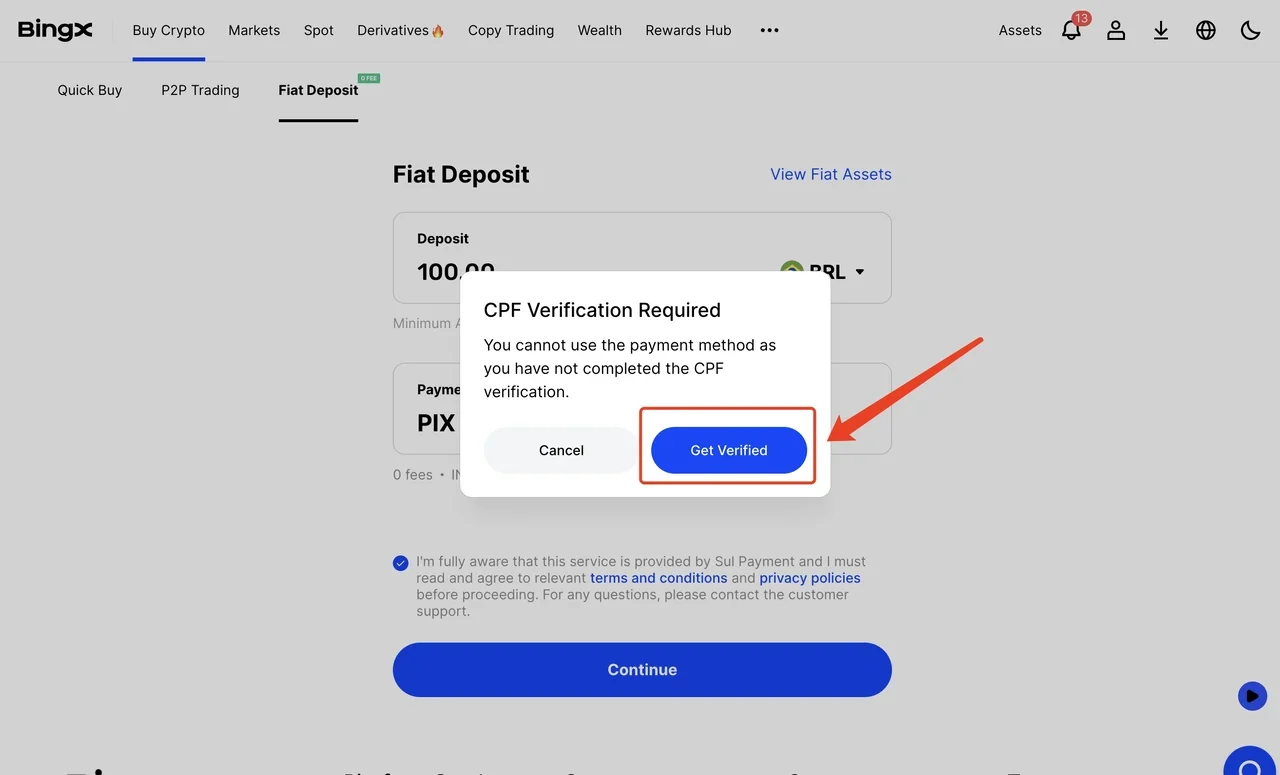
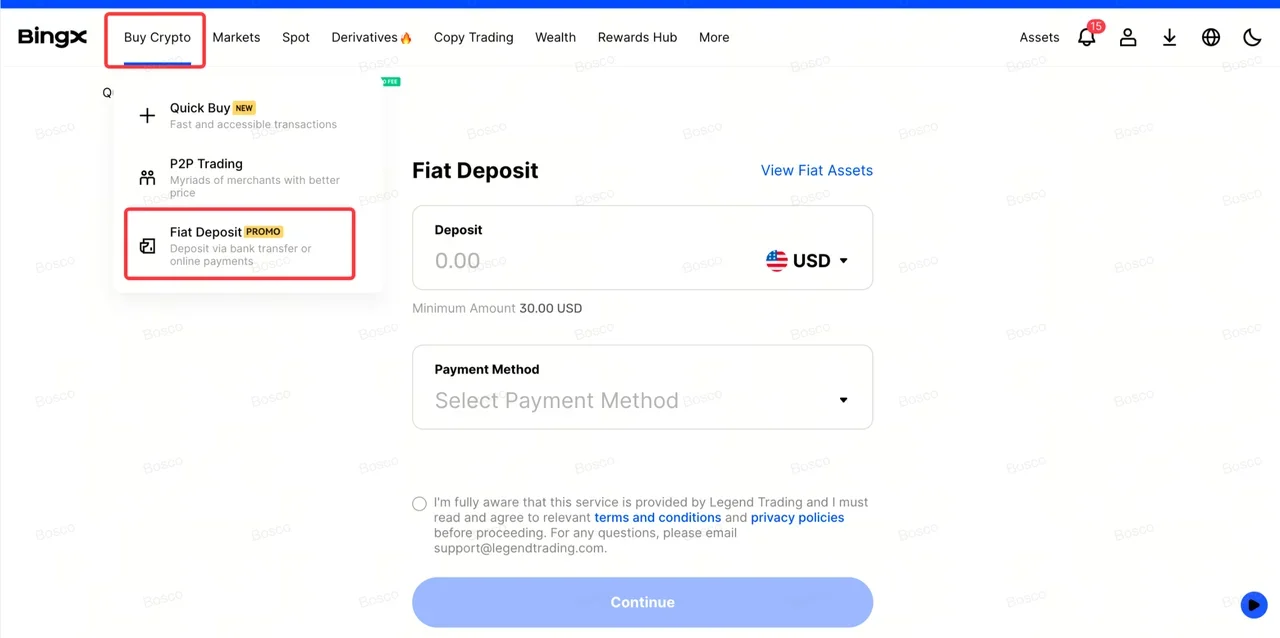
2. Access the Fiat Deposit Portal: Navigate to Buy Crypto and Fiat Deposit on the BingX app or web. Set your currency to BRL to activate local payment rails.
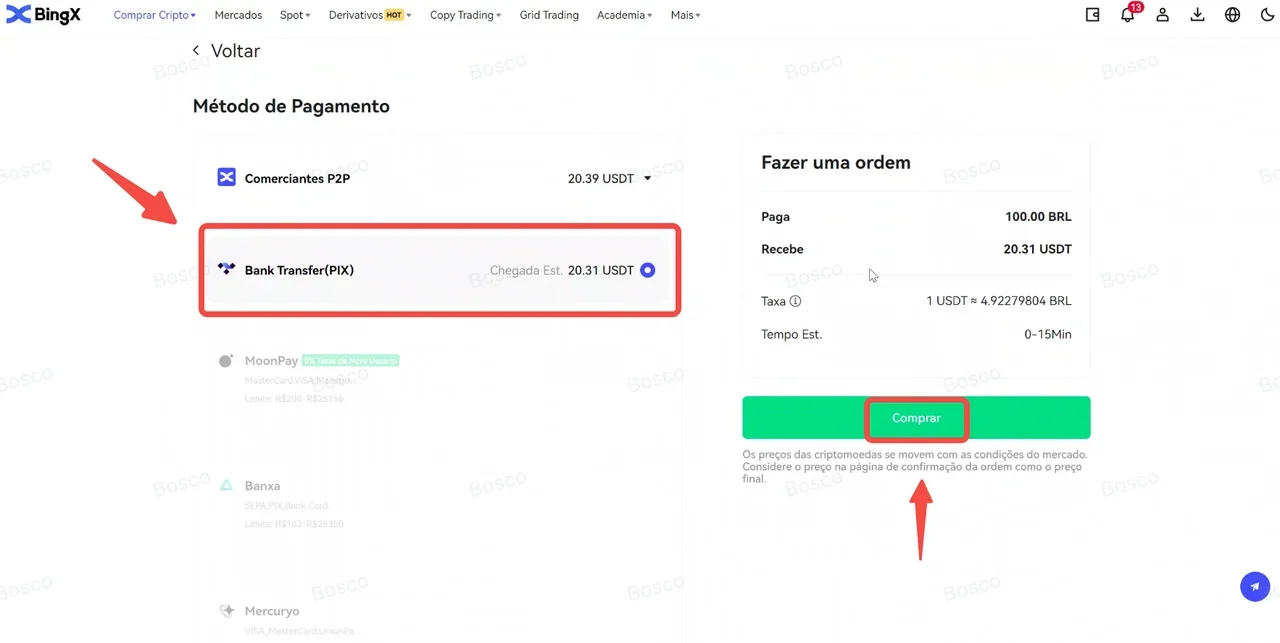
3. Select PIX as Your Payment Method: Choose PIX and enter your deposit amount. Fees are optimized between 0% and 0.5%, bypassing the heavy 3.5%–7% costs associated with credit cards and bank spreads.
4. Generate and Scan the QR Code: Scan the unique PIX QR code using your banking app. e.g., Nubank, Itaú.
Critical: The bank account must match the CPF on your BingX profile. Third-party transfers will be automatically reversed per 2026 AML rules.
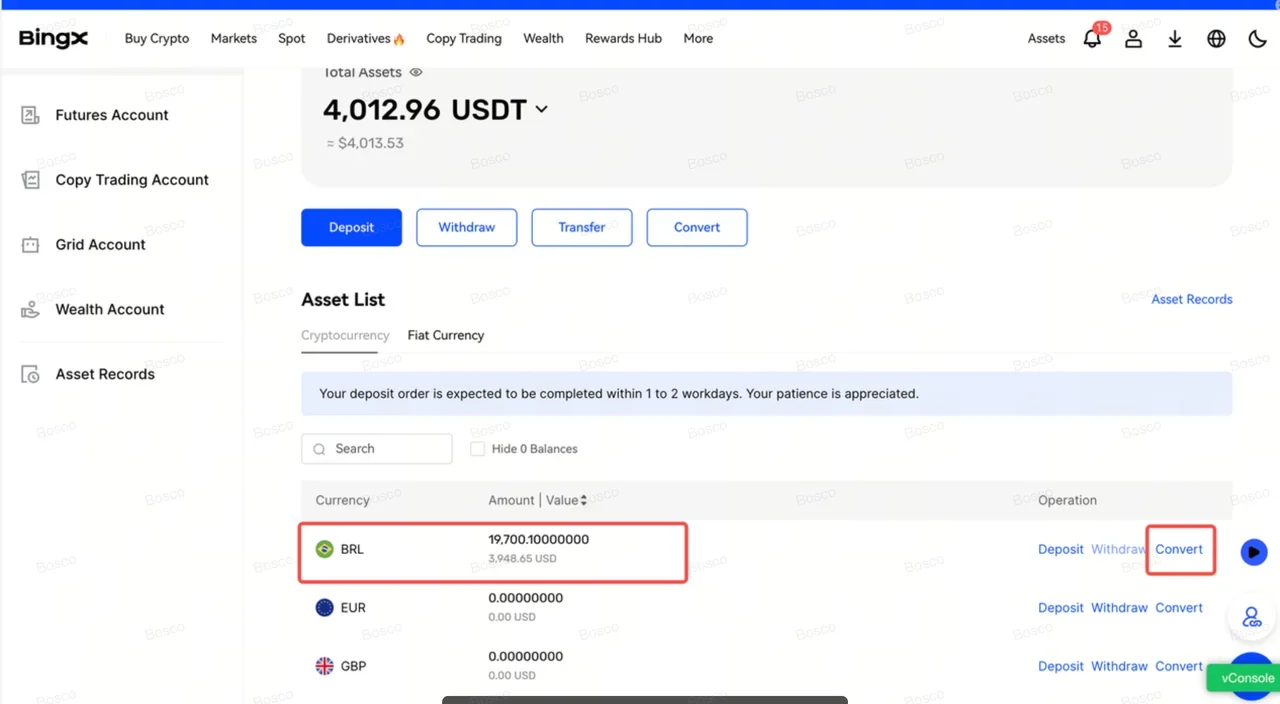
5. Convert BRL to Crypto Once credited (usually less than 10 seconds), go to Assets and Fund Account and use the BingX Convert feature to swap BRL for USDT, BTC, or ETH.
Final Thoughts: Ensure Compliance with Brazil Regulations When Trading on BingX
In 2026, the most effective strategy for a Brazilian investor is to maintain a Dry Powder balance of USDT on BingX, funded via PIX. This approach effectively bypasses the 3.5%–7.0% all-in costs and bank blocks associated with credit cards during periods of high market volatility. By utilizing the Central Bank’s instant settlement network, you ensure that your capital is converted at the exact market price displayed on your screen, eliminating the slippage and settlement friction inherent in legacy bank transfers or Boletos.
To trade on BingX safely, finalizing your compliance profile with Advanced KYC is the most practical step you can take. A verified account not only unlocks the BingX P2P Marketplace for more competitive BRL/USDT rates but also ensures your activity remains fully documented for the 17.5% flat capital gains tax reporting required by the Federal Revenue Service. Adhering to these standards transforms regulation from a hurdle into a protective shield, allowing you to navigate the Brazilian market with the same security as a traditional financial institution.
Risk Warning: Digital asset trading involves significant risk. Ensure you are familiar with the 17.5% flat tax on capital gains implemented in June 2025. BingX is not a tax advisor; always consult with a local professional regarding your individual tax liabilities in Brazil.
Related Reading
- How to Buy Your First Crypto in Brazil Using PIX: A Step-by-Step Guide (2026)
- Choosing Your Path to Crypto: CEX vs. DEX vs. P2P On-Ramps in Brazil (2026 Guide)
- Cashing Out: How to Sell Crypto and Withdraw Brazilian Reals (BRL) in 2026
- A Deep Dive into On-Ramp Fees in Brazil: PIX, Boleto, Credit Card, and Bank Transfer (2026 Guide)