

Steem (STEEM) is a veteran blockchain protocol designed specifically for social media and content-driven applications. Launched in 2016, Steem was the first project to successfully implement a Write-to-Earn model, allowing users to earn cryptocurrency rewards for posting, commenting, and upvoting content. By leveraging a Delegated Proof-of-Stake (DPoS) consensus, Steem eliminates the high transaction fees and slow processing times that plague other blockchains, making it an ideal infrastructure for micro-transactions within social networks.
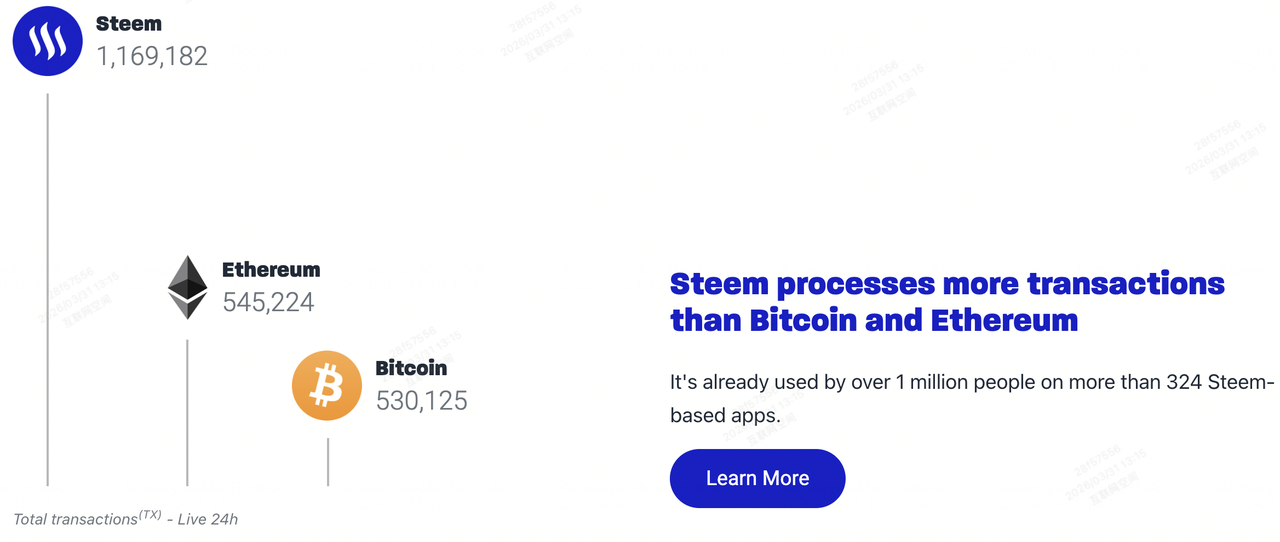
Steem vs. Ethereum and Bitcoin | Source: Steem
As of March 2026 the Steem ecosystem remains a resilient pillar of the Decentralized Social (DeSo) movement. With over 1 million users and more than 320 Steem-based apps, including the flagship Steemit and the newer HARI RAID Tap2Earn game, Steem continues to process over 1.1 million transactions daily, often exceeding the transaction counts of Bitcoin and Ethereum combined.
This article examines how Steem’s Proof-of-Brain mechanism rewards human intelligence, the utility of its three-token economy, and how to trade STEEM on BingX.
What Is the Steem (STEEM) Blockchain?
Steem is a publicly accessible database for immutably stored content in the form of plain text. Unlike traditional social media platforms where shareholders capture 100% of the value generated by user content, Steem flips the model by returning value to the contributors. It serves as a decentralized Content Management System (CMS) where any developer can pull data to build social applications.
The platform’s core thesis is that everyone’s meaningful contribution to a community should be recognized. To support this, Steem has developed a specialized architecture:
- Proof-of-Brain: A consensus-based rewards algorithm that uses a Wisdom of the Crowd voting system to distribute tokens to content creators.
- Feeless Operations: Using an intelligent bandwidth allocation system, Steem allows users to post and transfer tokens without paying gas fees.
- Fast Finality: Transactions are processed every 3 seconds, 24/7, ensuring a real-time experience comparable to centralized apps like X or Reddit.
How Does the Steem Ecosystem Work?
Steem operates as an application-specific blockchain that optimizes for social interaction:
- Delegated Proof-of-Stake (DPoS): Steem uses 21 elected Witnesses to produce blocks. This is significantly more energy-efficient than Proof-of-Work and allows the chain to scale to 10,000+ transactions per second.
- The Rewards Pool: Every year, a fixed amount of new STEEM tokens is created. 75% of this inflation is directed into a Rewards Pool, which is then distributed to creators and curators based on the votes they receive.
- Bandwidth & Resource Credits: To prevent spam, every user has a limited amount of bandwidth. The more Steem Power you hold, the more actions like posts, transfers, and votes you can perform per day.
- Hierarchical Private Keys: Steem uses a multi-tier key system of Posting, Active, and Owner keys. This allows users to keep their money keys offline while using a posting key for daily social interactions, dramatically increasing security.
What Are Steem's Tokens STEEM, SP, and SBD?
To maintain a stable and liquid economy, Steem employs a unique three-token model:
- STEEM: The liquid base token. It can be traded on exchanges or Powered Up to gain influence.
- Steem Power (SP): STEEM committed to a 4-week vesting schedule. SP holders earn 15% of annual inflation and have more weight in voting for content and Witnesses.
- Steem Blockchain Dollars (SBD): A stable-ish token designed to be pegged to $1 USD. SBD gives creators a reliable way to gauge their earnings in real-world terms.
What Is Steem (STEEM) Tokenomics and Inflation?
The STEEM token does not have a hard cap. Instead, it uses a decreasing inflation model to fund the ecosystem's growth. The inflation rate started at 9.5% in 2016 and decreases by 0.01% every 250,000 blocks, equivalent to roughly 0.5% per year.
Distribution of New STEEM Tokens
- 75% Reward Pool: Split between authors and curators.
- 15% Vested Holders: Distributed to those holding Steem Power.
- 10% Witnesses: Rewarding the block producers.
Steem vs. Ethereum: What Is the Difference?
Steem is a content-focused blockchain designed for social media and creator monetization, while Ethereum is a general-purpose smart contract platform powering DeFi, NFTs, and thousands of dApps. Steem offers near-zero fees and fast transactions with 3-second block time using a Delegated Proof-of-Stake (DPoS) model, making it ideal for high-frequency actions like posting and voting. In contrast, Ethereum uses Proof-of-Stake since 2022 with a larger, more decentralized validator set and supports complex programmable applications, though it can have higher fees depending on network demand.
From an ecosystem and investment perspective, Ethereum dominates with over $100 billion total value locked (TVL) at peak cycles and a massive developer base, driving real demand across DeFi, gaming, and tokenization. Steem’s value is more niche, tied to its social media economy and reward distribution system, where users earn STEEM for content engagement. Practically, Ethereum is better suited for building and investing across broad Web3 use cases, while Steem is optimized for content creators seeking fast, low-cost monetization within a dedicated platform.
|
Feature |
Steem (STEEM) |
Ethereum (ETH) |
|
Primary Goal |
Decentralized Social Media |
General Purpose Smart Contracts |
|
Fees |
Zero Fees (Bandwidth-based) |
Variable Gas Fees (Pay-per-action) |
|
Transaction Speed |
3 Seconds |
12-15 Seconds |
|
Native Storage |
Stores Plain Text On-Chain |
Optimized for Code execution |
|
Incentives |
Built-in Proof-of-Brain Rewards |
Third-party DApp incentives |
While Ethereum is a World Computer, Steem is effectively the World’s Advertising and Content Network. On Ethereum, every Like or Comment requires a gas fee, which is a non-starter for social media. Steem’s bandwidth model allows for a seamless, fee-free user experience while still maintaining security against Sybil attacks.
How to Trade Steem (STEEM) on BingX
Maximize your trading efficiency by using BingX AI to analyze real-time market sentiment and technical indicators for $STEEM during its 2026 SocialFi resurgence.
Long or Short Steem Perpetuals on BingX Futures
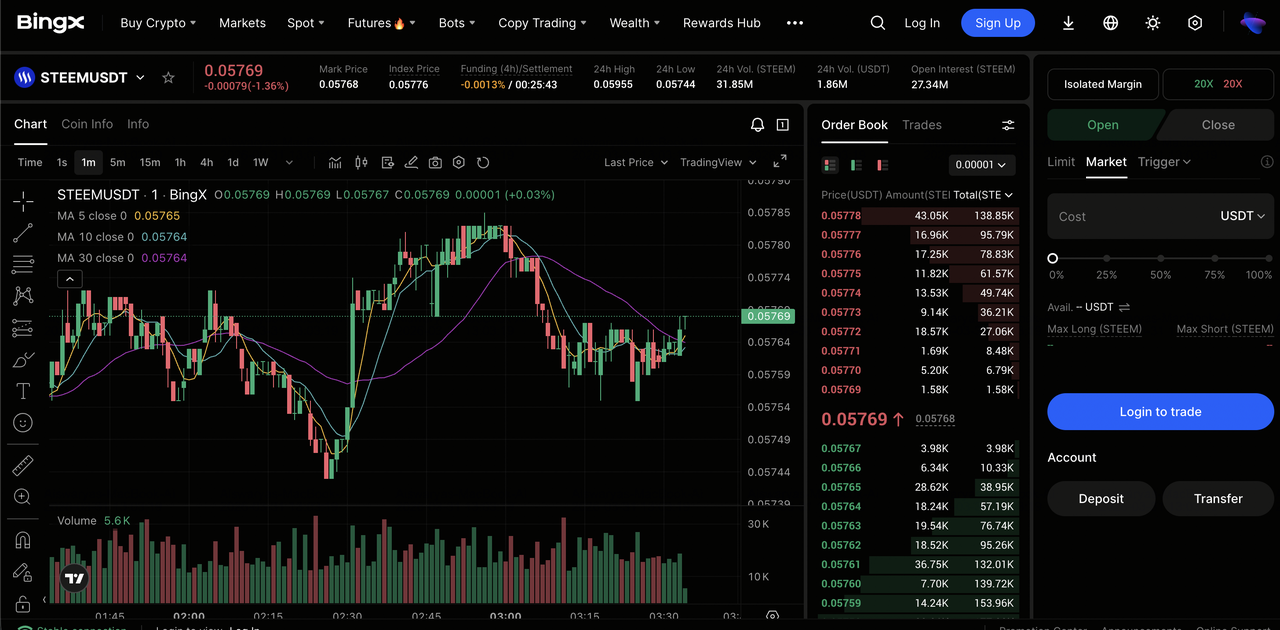
STEEM/USDT perpetual contract on BingX futures market
You can trade STEEM on BingX Futures if you want to speculate on price movements without holding the token directly. Futures trading also lets you use leverage, which can increase both potential returns and risk, so it is best to start with a clear plan and strict risk controls.
- Log in to your BingX account and fund your Futures account with USDT.
- Search for the STEEM/USDT futures contract in the BingX Futures market.
- Choose your preferred margin mode such as Cross Margin or Isolated Margin, then set your leverage level based on your risk tolerance.
- Decide whether you want to go long if you expect STEEM’s price to rise or short if you expect it to fall.
- Enter your position size and place a market order for instant execution or a limit order at your target entry price.
- Set Stop-Loss and Take-Profit levels before confirming the trade to help manage downside risk and lock in gains.
- Monitor your open position closely and close the trade manually or let your preset exit levels execute automatically.
For practical risk management, keep leverage moderate, avoid overallocating to one trade, and use BingX risk tools to manage volatility, especially during sharp market moves.
5 Key Considerations Before Investing in Steem (STEEM)
Before investing in Steem (STEEM), it’s important to evaluate key factors that can impact its long-term value, adoption, and risk profile.
- Inflationary Supply: Unlike Bitcoin, STEEM is inflationary to support constant content rewards. Long-term value depends on demand for influence or Steem Power outpacing new supply.
- Platform Dependency: The value of STEEM is closely tied to the health of Steemit and other dApps in the ecosystem.
- Governance Risks: As a DPoS chain, governance is controlled by the top 21 Witnesses. Large stakeholder shifts can lead to significant protocol changes.
- Social-Fi Competition: Newer DeSo protocols like Based, Farcaster, or Lens offer modern features that compete for the same user base.
- Vesting Period: It takes 4 weeks to withdraw Steem Power back into liquid STEEM, meaning your capital is not instantly accessible if staked.
Final Thoughts: Is Steem (STEEM) Still Relevant in 2026?
As of March 2026, Steem remains a functional and niche SocialFi infrastructure, particularly strong in decentralized publishing and community-driven reward systems. Its zero-fee model and fast transaction speeds of around 3 seconds continue to differentiate it from most blockchains, making it practical for high-frequency user interactions like posting, voting, and tipping. However, its growth trajectory is more modest compared to newer ecosystems, and its relevance largely depends on sustained user activity and platform-level innovation.
From an investment perspective, STEEM can be viewed as a targeted bet on the attention economy, where value is driven by content creation, engagement, and influence via Steem Power. That said, adoption risks, competition from newer SocialFi and AI-driven platforms, and relatively lower developer momentum should be considered. As with any crypto asset, STEEM is subject to market volatility, liquidity risks, and ecosystem dependency, so you should assess your risk tolerance and avoid overexposure when building a position.
Risk Reminder: Digital asset investments, particularly in social tokens like STEEM, carry market risk and price volatility. Always perform your own research and only trade capital you can afford to lose. BingX is not responsible for any trading losses.