
The digital asset landscape is shifting from pure speculation to sustainable, asset-backed returns. R2 Protocol (R2) stands at the forefront of this transition, acting as a Robinhood for tokenized yield. Launched on March 30, 2026, the protocol bridges the gap between traditional finance (TradFi) and DeFi by wrapping complex off-chain credit strategies into simple, yield-bearing on-chain products.
While traditional DeFi yields often rely on inflationary token emissions, R2 generates value from real-world economic activity. On March 30, 2026, R2 reached a major milestone with its listing on Binance Alpha and a successful community airdrop, signaling a new era for institutional-grade liquidity on the BNB Chain.
This article explores the inner workings of R2’s three-layer architecture, the risk-tiered strategy of its vaults, the utility of the $R2 token, and how it empowers everyone from retail users to corporate treasuries.
What Is R2 Protocol (R2)?
R2 Protocol is an on-chain wealth management layer designed for serious capital. Unlike trading platforms that prioritize high-frequency turnover, R2 is built on the principle that capital should be allocated, not speculated. It serves as a decentralized aggregator that connects stablecoin liquidity with regulated, off-chain yield providers like Securitize and Mercado Bitcoin.
The platform targets four primary user segments:
- Individual Users: Seeking predictable stablecoin yield without complex farming.
- SMEs & Corporate Treasuries: Managing idle cash with clear redemption rules.
- Family Offices: Allocating to long-term, risk-defined RWA horizons.
- Integrated Partners: Wallets and exchanges looking to offer plug-and-play RWA exposure.
How Does R2 Protocol Work?
R2 operates through a modular, three-layer system that isolates risk while maintaining full on-chain transparency.
1. The User Layer
This is the entry point where users deposit stablecoins like USDC or USDT. R2 abstracts away the technical hurdles of RWA onboarding, such as KYC for individual assets, by allowing users to interact with a unified interface.
2. The Vault Layer (The Core Logic)
The Vault Layer is where capital is organized into distinct strategies. Each vault is an independent silo with its own liquidity rules and risk profile:
- R2 Reserve (Low Risk): Focused on capital preservation. It allocates to short-duration products like VBill and STAC (Treasuries). Redemptions typically follow a T+3 settlement timeline.
- R2 Prime (Medium Risk): Designed for higher yield through longer-duration strategies, including private credit (Apollo Acred) and diversified exposures like gold or energy. It features a 12-month maturity followed by T+7 redemption.
3. The Asset Layer
R2 does not custody assets directly. Instead, it routes pooled capital to a network of regulated custodians and institutional platforms. Yields are generated off-chain in the real world and settled back on-chain, where they are distributed to users via the appreciation of R2USD, the protocol's native yield-bearing stablecoin.
What Is the $R2 Token Used For?
The $R2 token is the coordination engine of the protocol. While the protocol manages RWA yields, the native token handles the decentralized components of the ecosystem:
- Governance: Holders vote on new vault strategies and asset-layer partners.
- Staking Rewards: $R2 stakers receive a portion of the protocol's management fees.
- Ecosystem Incentives: Tokens are used to bootstrap liquidity and reward long-term vault participants.
- Partner Revenue Share: $R2 is used to facilitate the incentive mechanism for partners bringing significant TVL to the platform.
What Is R2 Protocol (R2) Tokenomics and Distribution?
The $R2 token has a fixed maximum supply of 1,000,000,000 (1 billion). The distribution is heavily weighted toward the community to ensure decentralized ownership.
R2 Token Allocation
- Community (50.00%): Distributed gradually through community incentives, participation rewards, and liquidity programs.
- Ecosystem (19.50%): Dedicated to supporting partnerships, third-party integrations, and long-term protocol growth.
- Treasury (10.00%): Reserved for operational expenses, strategic initiatives, and maintaining protocol sustainability.
- Investors (8.50%): Subject to a 12-month cliff, followed by a 24-month linear vesting period.
- Advisors & Future Strategic (7.00%): Allocated for strategic guidance and future financing rounds to ensure long-term alignment.
- Team (5.00%): Subject to a 12-month cliff, followed by a 24-month linear vesting schedule for core contributors.
How Does R2 Protocol Differ From Traditional DeFi Yields?
|
Feature |
R2 Protocol (R2) |
Typical DeFi Yield |
|
Yield Source |
Real-World Assets (Treasuries, Credit) |
Token Emissions / Dex Trading Fees |
|
Risk Profile |
Structured & Tiered (Reserve vs Prime) |
High (Often correlated to market volatility) |
|
Liquidity |
Defined Settlement (T+3 to 12-months) |
Usually instant (but subject to slippage) |
|
Transparency |
On-chain audit of off-chain assets |
Smart contract code audit |
R2 Protocol shifts the DeFi yield paradigm from circular reflexivity to exogenous value. Traditional DeFi yields are primarily internal, generated through inflationary token emissions, high-leverage liquidations, or DEX trading fees that fluctuate with crypto market volatility. In contrast, R2’s yield is external, sourced from a $6.52M TVL backed by regulated, institutional-grade RWAs. By providing structured access to 7.72% 90D APY through tokenized U.S. Treasuries and private credit, R2 decouples user returns from the PvP (player-vs-player) mechanics of crypto-native protocols, offering a yield floor anchored in global credit markets rather than speculative trading volume.
Practically, R2 replaces instant but uncertain liquidity with explicit, rule-based settlement. While most DeFi protocols allow instant withdrawals, often at the cost of high slippage or pool imbalance, R2 Protocol utilizes a layered vault architecture with predefined liquidity boundaries. For example, the R2 Reserve follows a T+3 settlement cycle suited for cash management, while R2 Prime utilizes a 12-month maturity for duration-matched institutional credit. This prevents the bank run risks associated with mismatched liquidity, ensuring that capital is allocated deliberately across time horizons rather than chasing short-term, unsustainable farm incentives.
How to Trade R2 Protocol (R2) on BingX
Maximize your trading precision by leveraging BingX AI to analyze real-time market sentiment and institutional RWA capital flows during the $R2 token’s high-volatility launch phase.
Long or Short R2 Perpetuals on the Futures Market
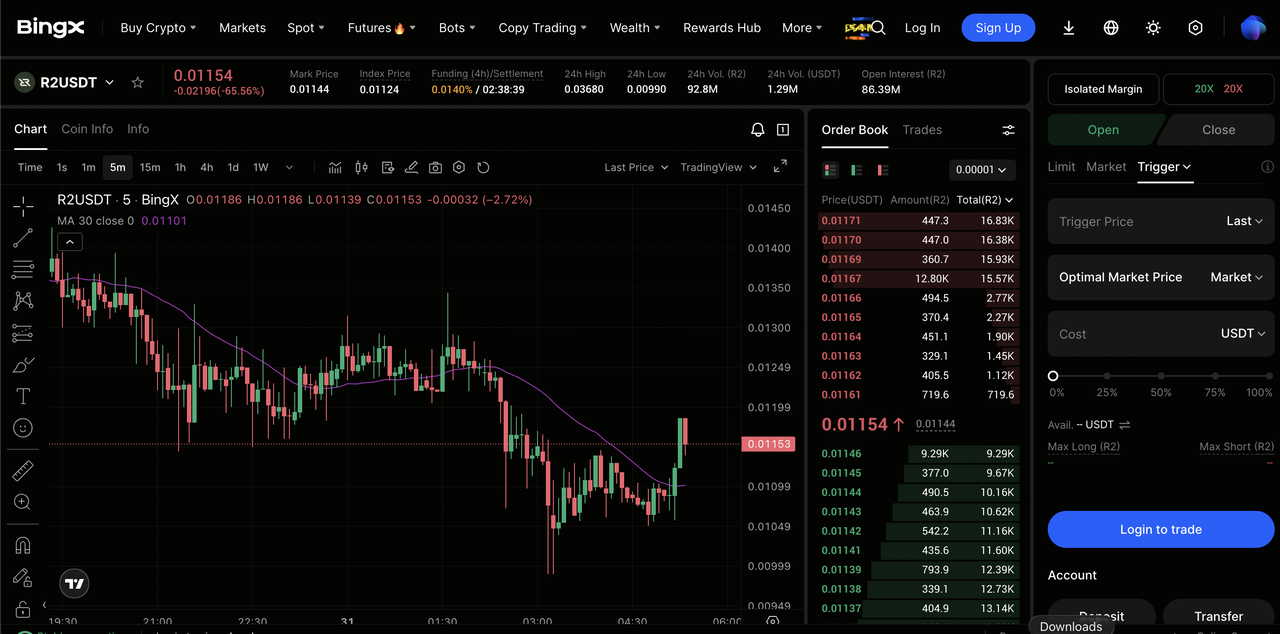
R2/USDT perpetual contract on the BingX futures market
- Access the Terminal: Navigate to the Futures tab on the BingX app or web interface and search for the R2/USDT perpetual contract.
- Select Margin Mode: Choose Isolated Margin to cap your risk to a single position or Cross Margin to utilize your entire account balance as collateral.
- Set Leverage & Direction: Adjust your leverage, e.g., 5x or 10x, based on your risk tolerance and select Long if you anticipate RWA sector growth or Short to hedge your vault positions.
- Execute Order: Use BingX AI-powered trend analysis to identify optimal entry points, then place a Limit or Market order to finalize your position.
5 Key Considerations Before Investing in R2
Before allocating capital to the R2 Protocol, it is essential to evaluate the structural differences between traditional DeFi liquidity and the settlement cycles inherent to institutional real-world assets.
- RWA Settlement Cycles: Unlike pure crypto-native apps, redemptions depend on TradFi settlement (T+3 or longer). It is not for emergency liquidity.
- No Guaranteed Returns: While backed by Treasuries and credit, yields fluctuate based on global interest rates and macro conditions.
- Regulatory Dependency: The protocol relies on third-party RWA issuers; any change in their regulatory status could impact the underlying assets.
- TGE Price Discovery: As a newly listed token in March 2026, expect high volatility in the $R2 price as early airdrop recipients find exit or entry points.
- Smart Contract Risk: While the assets are real-world, the gateway is a smart contract. Always verify audit reports before depositing large sums.
Final Thoughts: Is R2 Protocol Driving the Shift to On-Chain Capital Allocation?
As of late March 2026, R2 Protocol has transitioned from a specialized yield aggregator into a foundational infrastructure layer for institutional-grade finance on the BNB Chain. By integrating a $6.52 million TVL with a transparent, vault-based architecture, the protocol offers a structured alternative to the high-volatility, emission-based rewards common in traditional DeFi. Its long-term value proposition is structurally tied to the global demand for tokenized RWAs and the platform's ability to maintain its 7.72% 90D APY through diversified, off-chain credit strategies.
For the strategic investor, the R2 ecosystem serves as a primary case study for the flight to quality, where on-chain efficiency meets the stability of traditional credit markets. Success in this environment requires a balanced approach: utilizing R2’s risk-tiered vaults for capital preservation while remaining cognizant of the distinct settlement cycles that separate RWA protocols from instant-access liquidity pools. As the $R2 token enters its post-TGE phase, the protocol's focus remains on horizontal integration, merging stablecoin liquidity with the predictability and oversight of the regulated financial system.
Risk Reminder: Digital asset investments, particularly in RWA-backed protocols and newly listed tokens like $R2, carry inherent market and credit risks. The value of $R2 and its underlying yields may fluctuate based on interest rate shifts, smart contract vulnerabilities, and regulatory changes. Always perform your own research and only trade capital you can afford to lose. BingX is not responsible for any trading losses incurred.